
|
"... strength and stiffness, workability, impact and fire resistance." |
Oriented Strand Board
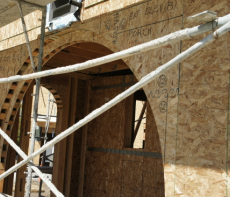
OSB is the superior product in most construction applications. It
is approved by all major building codes, and it is now the material of choice
in commercial and residential constructions and remodeling for walls, roofs,
floors, etc. OSB is a solid panel product of consistent quality with no core
voids, knotholes, or delamination problems, OSB delivers exceptional
performance, uniformity, strengths, and durability.
OSB (oriented strand board) is made from a process in which trees are cut into strands the size of of around 2.5 x 15 cm / 1 x 6 inch. The strands are then coated with an adhesive mixture, formed in multiple oriented layers, and pressed together to make large, uniform, exceptionally strong boards of varying sizes and thickness. OSB has numerous residential and commercial applications, and is gaining popularity in markets such as materials handling and the manufacturing of upholstered furniture. It is extensively used for wall sheathing, floor underlayment, roof cover, and I-joist in both residential and commercial construction. Some of the significant advantages of OSB include strength and stiffness, workability, impact and fire resistance. OSB panels can be manufactured from a wide range of fast-growing species and from relatively small trees. The highly automated production process utilizes a maximum amount of wood fiber from each tree providing an exceptionally high yield of the finished product.Due to breakthrough innovations in adhesive technology and emission control technology, modern OSB manufacturing is a very low emission and water consumption industry. Today, total OSB production in North America is approximately 706 million ft3 (20 million m3), and there are about 20 companies that manufacture OSB in the United States, Canada and Europe. |
|
Atlant-Pacific LLC | 3626 Geary Blvd., Suite 206 San Francisco, CA 94118 | Tel: (415) 876-6199